Fitbit Air live heart rate on Android
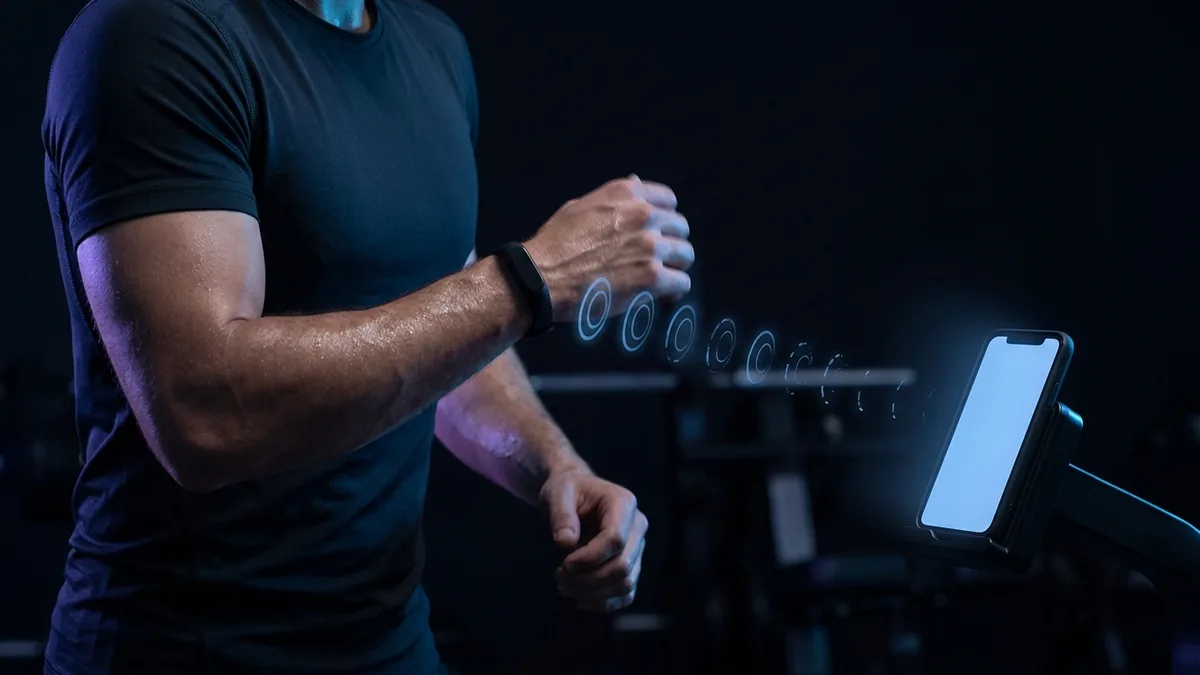
You connect your Fitbit Air to a heart rate app, train, and it works. You finish, go to start the next session, and the band is not in the list any more. Turning sharing off and on in Google Health brings it back, once, and then the same thing happens again. This is the most common thing people write to us about, so here is what is actually happening and the three ways out of it.
What the band is actually doing
The Fitbit Air can send your live heart rate to other equipment and apps. Google's own help page for sharing real-time heart rate lists the Google Fitbit Air, the Fitbit Charge 6 and the Google Pixel Watch 2 or higher as the devices that can do it, and on the Air the setting is "Share heart rate", in the band's Connections menu inside Google Health.1
What it sends is not proprietary. It is the Bluetooth Heart Rate Service (0x180D), a published Bluetooth SIG profile,2 which is the same thing a Polar or Garmin chest strap sends and the reason any third-party app can read the band at all.
The important word is sharing. Broadcasting is a mode the band enters, not a permanent property of it. While sharing is on, the Air behaves like a chest strap. While it is off, it is not a Bluetooth heart rate sensor at all, and nothing on your phone can see it.
Why it disappears between sessions
Three ordinary facts stack up into the loop you are stuck in.
A scan can only show what is advertising right now. A sensor list is not a list of devices you own, or even devices you have paired with. It is a list of what is broadcasting in the room at that moment. ZonePoints drops a sensor from the list within seconds of its advertisements stopping, and every other Bluetooth app does the same, because there is nothing else to show.
A band that is busy is not advertising. Sharing is a one-to-one connection. Google's page notes that the Charge 6 can connect with only one piece of equipment or app at a time, and that a Pixel Watch 3 or later manages a maximum of two.1 While an app holds the connection, there is nothing for a second scan to find.
Sharing tends to end when the workout does. This is the part that catches people. Fitbit users have reported the sharing connection dropping at the end of a workout and needing to be started again from scratch, a recurring complaint on the Fitbit Community about heart rate sharing on the Charge 6.4 Once your app disconnects at the end of a session, the band frequently leaves broadcast mode altogether rather than going back to advertising.
Put together: you share, you connect, you train, you finish, the band goes quiet, and the next scan finds nothing. Nothing is broken and you are not doing it wrong.
Fix 1: turn on "Always visible"
Before changing anything else, check this toggle. In Google Health, open your Fitbit Air, find "Share heart rate", and turn on "Always visible".
With it on, the band keeps broadcasting in the background and Google Health does not need to be open while you train. That is the difference between a band that is discoverable when you go looking for it and one that only exists for the two minutes after you press a button.
Two things to know before you leave it on:
- It costs battery. Google states plainly that sharing real-time heart rate to fitness equipment impacts your device's battery life.1 A band broadcasting all day is a band charging more often.
- It is not a guarantee. If the band still vanishes after a session, switching "Share heart rate" off and back on before the next one resets the broadcast. That is the loop you already know, but with Always visible on you will usually not need it.
Fix 2: skip Bluetooth entirely
Here is the option most people never consider: if you do not need to watch your heart rate while you train, you do not need to connect to the band at all.
Your Fitbit workouts already sync into Health Connect, and a zone training app can read them from there afterwards, split them into sessions and score them. Nothing to pair, nothing to switch on, nothing to remember at the start of a workout. How that sync works covers the setup, which is a permission you grant once.
The trade is real and worth stating: you get the analysis after the session rather than the numbers during it. If your training is "go for an hour, see what it was worth", this is strictly less work than pairing. If you train by watching the zone you are in and adjusting, it is not enough on its own.
Fix 3: wear a chest strap
If you want live zones, the honest answer is that a strap is the tool for the job, and not only because it does not play hide and seek.
In "Variable Accuracy of Wearable Heart Rate Monitors during Aerobic Exercise", Gillinov and colleagues had 50 adults work on a treadmill, stationary bicycle and elliptical with a Polar chest strap and four optical wrist and forearm monitors all measured against ECG. The chest strap agreed with ECG almost exactly, at a concordance of 0.996, while the wrist monitors ranged from 0.81 to 0.92 — and on an elliptical with arm levers, not one of the optical monitors was accurate.3
A strap also solves the discovery problem as a side effect. It advertises whenever it is worn, so it is simply in the list when you open the app, and it reconnects on its own if the link drops mid-session. There is no mode to enter and nothing to switch on.
That matters most for intervals, where your heart rate changes faster than a wrist sensor can follow, and least for steady efforts, where a wrist reading is usually close enough.
Which one to pick
- You own the Air, you want live zones: turn on "Always visible" and accept the battery cost.
- You want the training scored, not watched: use Health Connect and stop pairing altogether.
- You do intervals, or your zones matter to you: wear a strap and use the Air for the rest of the day.
They are not exclusive. Plenty of people train with a strap and let Health Connect pick up the walks, rides and workouts they did not record deliberately.
Zone training with ZonePoints
ZonePoints is built for exactly this mix of sources on Android:
- Any standard Bluetooth sensor. A chest strap, an armband, or a Fitbit Air with sharing switched on — all the same standard
0x180Dprofile, connected from the home screen with no account and no sign-in. - Health Connect import. Workouts from Fitbit and other apps are imported and scored automatically, and time already covered by a session you recorded live is never counted twice.
- Five heart-rate-reserve zones, one score. Every session becomes one number, so a hard twenty minutes and an easy hour are comparable.
References
Try it on your next session
ZonePoints scores every workout from your heart rate. Free, no account, any Bluetooth strap.
- Google. Share your real-time heart rate with fitness equipment & apps. Google Health Help Center. support.google.com/googlehealth/answer/14236705
- Bluetooth SIG. Heart Rate Service (0x180D) specification. Bluetooth Special Interest Group.
- Gillinov S, Etiwy M, Wang R, et al. "Variable Accuracy of Wearable Heart Rate Monitors during Aerobic Exercise." Medicine & Science in Sports & Exercise. 2017.
- Fitbit Community. Constant issues sharing HR to devices since latest firmware update. Charge 6 forum thread.